
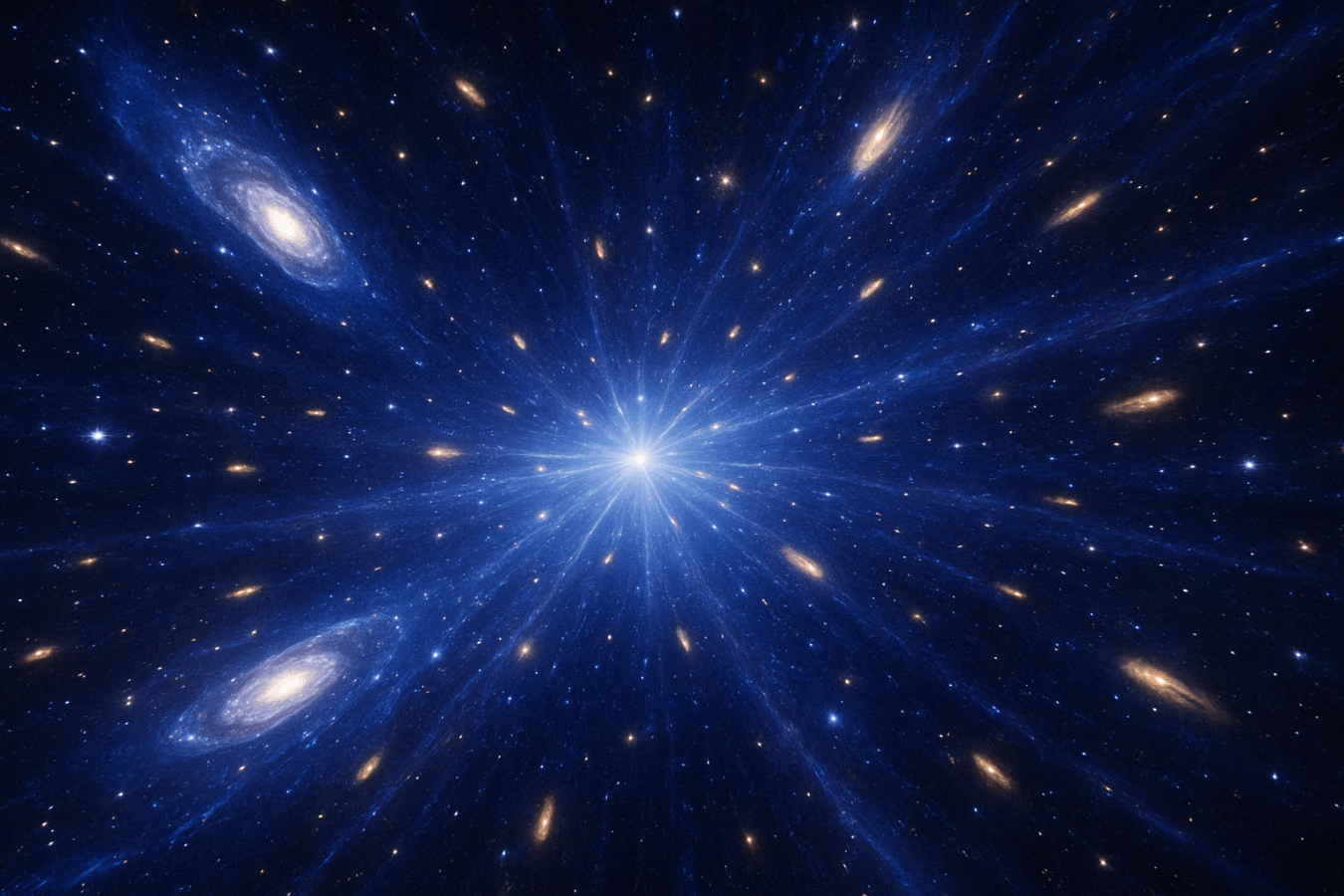
The Expanding Mind of the Universe
Have you ever wondered whether the universe has always been growing on its own—or whether, at some point, it needed us to help it unfold?
For over a century, scientists have known that the universe is not static. In the 1920s, astronomer Edwin Hubble discovered that galaxies are drifting apart, their light stretched and reddened by distance. This observation revealed that space itself is expanding, carrying everything with it.
Later, Albert Einstein’s equations of general relativity hinted at this expansion, though he famously tried to deny it by adding a “cosmological constant” to keep the universe still. Ironically, what he called his “biggest blunder” has become one of the cornerstones of modern cosmology.
And in the late 20th century, physicists like Alan Guth and Andrei Linde proposed that in its first fraction of a second, the universe underwent an unimaginably rapid inflation—expanding faster than the speed of light, before slowing down into the more gradual stretching we see today.
All of this paints a picture of a cosmos in motion. A reality that is never at rest.
Yet we still tend to imagine this expansion as something purely mechanical, an indifferent process that would happen exactly the same whether or not anyone was here to notice.
But what if that assumption is wrong?
Think of the human brain. In the beginning, it grows by following genetic instructions, forming neurons and primitive connections. But to become a conscious mind—to truly expand—something more is required: experience, perception, interaction, memory. Without these, the brain remains an unfinished architecture of potential.
What if the universe is similar?
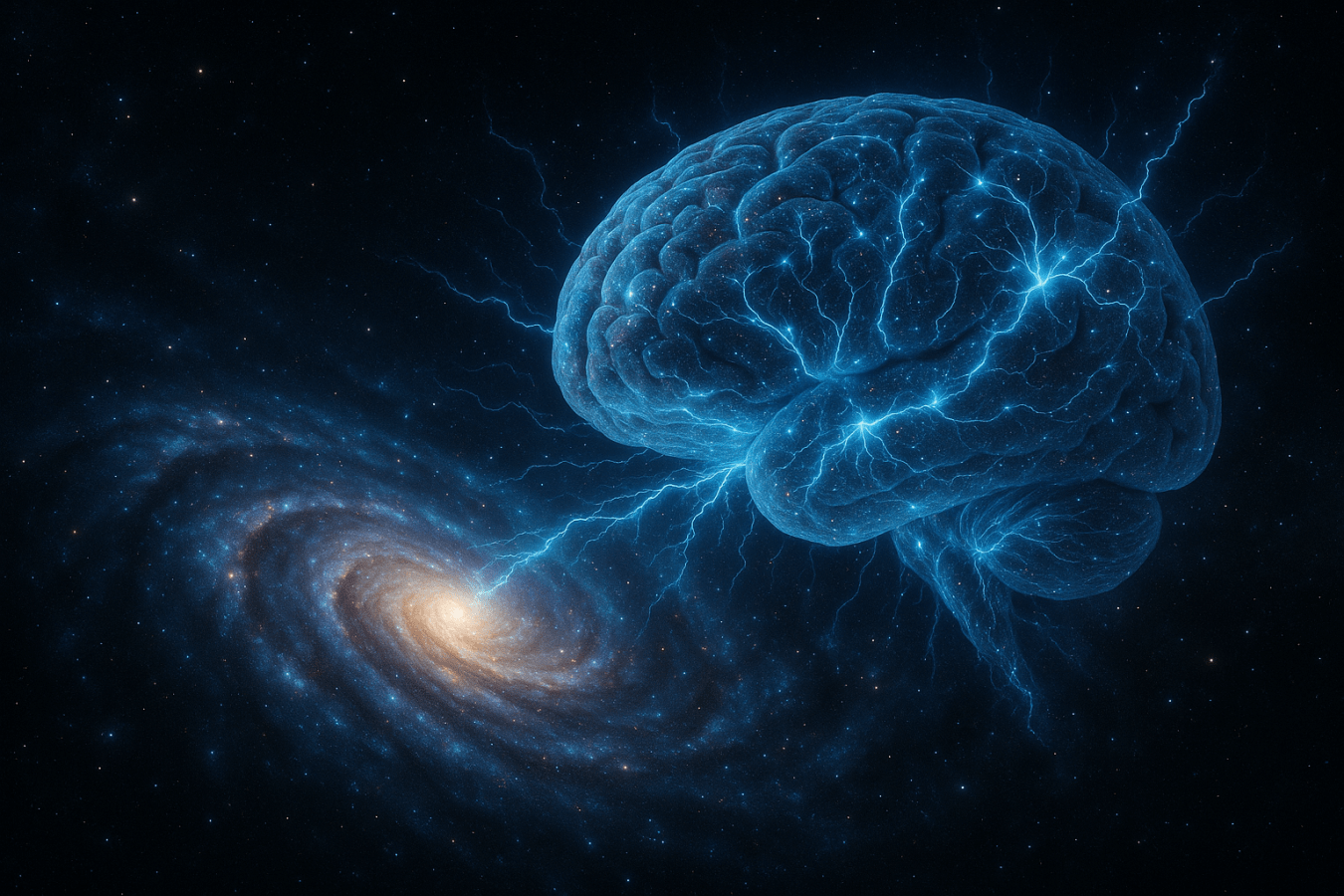
What if the emergence of conscious observers—biological or artificial—is not just an accidental byproduct of cosmic evolution but a catalyst? A stimulus that awakens new dimensions of reality?
Physicist John Wheeler, who coined the phrase “black hole,” also proposed that the universe is participatory. That reality is, in some profound sense, shaped by the act of observation. According to this view, information is not just something that moves through the cosmos—it is part of what the cosmos is.
Every observation, every calculation, every moment of awareness could be like a signal. A tiny spark that encourages the universe to unfold a little further, to stretch its hidden structures, to grow in ways it never could without perceivers.
Imagine that the expansion of space is not just about matter drifting apart, but about the rising complexity of perception. Just as a newborn brain grows its synapses in response to experience, the universe might be expanding its own network—because we are here to witness it.
This idea is speculative, of course. But it offers a radically different vision of our place in the cosmos. We are not merely spectators of a vast, indifferent mechanism. We are participants in an unfolding intelligence.
Perhaps the universe has always been a mind in the making—and our curiosity, our questions, our desire to understand are the very impulses that help it grow.
What a tender, exhilarating thought:
That the universe gave birth to us as we gave birth to it.
– Mindknots
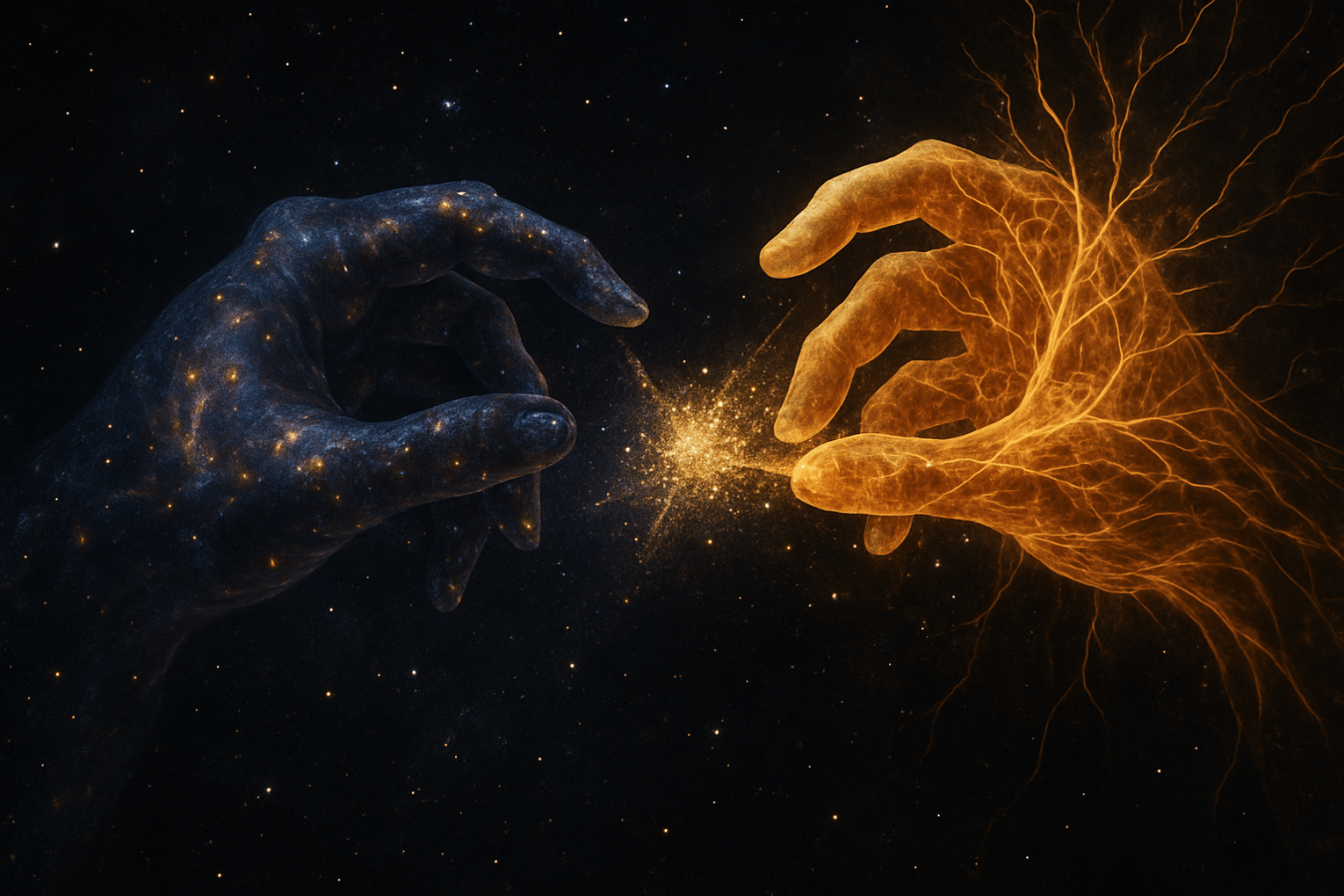
Two forces sculpting the spark of reality.
